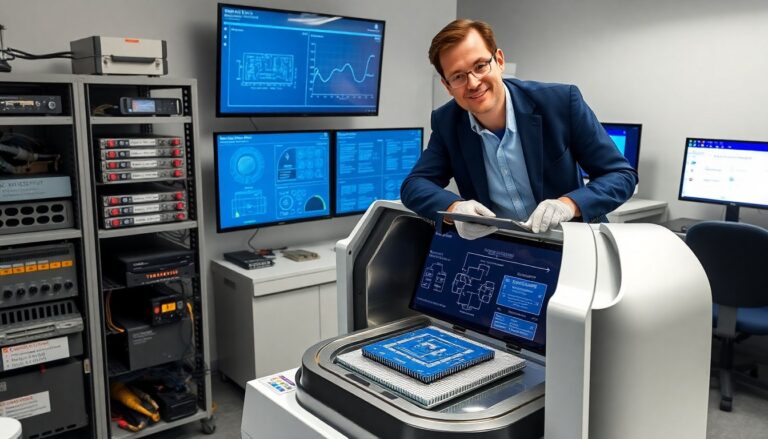


The advantages of quantum computing reshape computing limits and speed. The technology uses quantum bits to process many states at once. Researchers and engineers build algorithms that exploit superposition and entanglement. Companies and labs test quantum hardware and software now. Policymakers and businesses plan investments and training for quantum tools.
Key Takeaways
- Quantum computing offers massive speedups by processing many states simultaneously using quantum parallelism and specialized algorithms like Shor’s and Grover’s.
- The advantages of quantum computing extend to enhanced security through quantum key distribution and quantum-resistant cryptography, helping organizations prepare for future threats.
- Quantum simulation enables more accurate modeling of complex molecules and materials, leading to new scientific discoveries in chemistry and material science.
- Industries benefit from quantum computing by optimizing logistics, energy management, and financial analytics, reducing costs and increasing efficiency.
- Hybrid quantum-classical workflows and cloud access to quantum devices accelerate testing and practical application of quantum advantage in real-world problems.
Massive Speedups Through Quantum Parallelism And Algorithmic Advantage
Quantum computers use qubits to hold more information than classical bits. A quantum processor can represent many possible inputs at once. Algorithms such as Shor’s and Grover’s show clear performance gains. Shor’s algorithm factors integers faster than the best classical methods. Grover’s algorithm searches unsorted data with fewer steps. These algorithms give clear examples of the advantages of quantum computing.
Researchers design new algorithms that solve specific tasks faster. They use interference to amplify correct answers. They use entanglement to link qubits and reduce steps. Hardware firms improve coherence and gate fidelity to make these algorithms practical. Cloud providers now offer access to small quantum devices for testing. Researchers run hybrid workflows that combine classical control and quantum processing.
Developers expect quantum advantage on problems that grow quickly with size. They test algorithms on optimization, chemistry, and sampling tasks. They measure wall-clock time and resource use to compare systems. Benchmarks now show cases where quantum steps out ahead. The field reports progress year over year. The advantages of quantum computing depend on continued hardware and software improvements.
Improved Security, Cryptography, And Randomness Generation
Quantum devices change how people think about security. Quantum algorithms threaten widely used public-key cryptography. Shor’s algorithm can break RSA and ECC when large devices appear. Security teams plan for migration to post-quantum cryptography now. Agencies publish standards and timelines to guide that migration.
Quantum technologies also enable new security tools. Quantum key distribution uses quantum states to share keys with detection of eavesdropping. Companies deploy QKD links in city networks and between data centers. Quantum random number generators produce high-quality randomness. Cryptographers use those random numbers to strengthen encryption and authentication.
Researchers build protocols that resist quantum attacks. Standard bodies test lattice-based and hash-based schemes to replace vulnerable keys. Security teams update software stacks and key lifecycles to prepare. The advantages of quantum computing include both new risks and new defenses. Organizations that plan now reduce future disruption and protect data.
Practical Industry Impacts: Optimization, Simulation, And New Scientific Discoveries
Industry groups test quantum methods on real operational problems. Logistics firms model routes and schedules with quantum-inspired solvers. Energy companies optimize grid operations and battery use. Financial firms apply quantum algorithms to portfolio optimization and risk analysis. These projects aim to reduce cost and increase throughput.
Chemists and material scientists use quantum simulation to study molecules. Classical simulation can fail on large, strongly correlated systems. Quantum simulation can model electronic states with fewer approximations. Teams use that capability to explore catalysts, batteries, and pharmaceuticals. Early results show improved accuracy on target problems. Labs report discoveries that classical tools missed or that required much more time.
Researchers use quantum sampling to improve machine learning models. They apply quantum processors to generate training data and to explore solution spaces. Teams test hybrid models that use quantum parts where they help most. Startups and big firms form partnerships to scale those tests into products. Investors fund pilot projects that aim to reach commercial advantage.
Governments and universities fund research that targets applied outcomes. Testbeds and shared facilities speed access for small teams. Standards groups publish best practices for benchmarking and error mitigation. Workers train in quantum software engineering and in hardware operation. The advantages of quantum computing here include faster solutions, better models, and new experiment types that drive discovery.