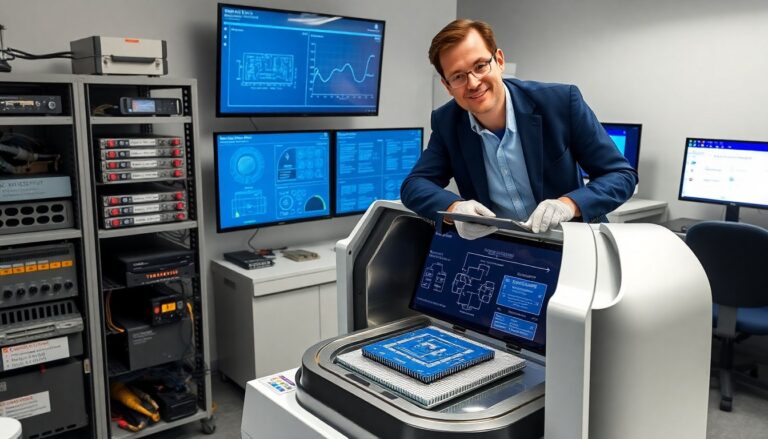


Quantum computing vs classical computing sits at the top of tech debates in 2026. The article explains core differences, practical impacts, and near-term expectations. It keeps language simple. It focuses on facts, use cases, and timelines. It avoids hype. It helps readers compare strengths, limits, and realistic steps forward.
Key Takeaways
- Quantum computing vs classical computing differs fundamentally, with quantum using qubits that leverage superposition and entanglement to process complex problems more efficiently.
- Classical computing excels in predictable, broad applications but faces physical and algorithmic limits that quantum computing aims to address.
- Quantum advantages are prominent in cryptography, molecular simulation, and optimization, yet current quantum devices face challenges like high error rates and hardware scaling.
- Practical quantum computing at scale is anticipated by the late 2020s or early 2030s, with early specialized uses emerging sooner on cloud quantum platforms.
- Enterprises should prepare now by adopting post-quantum cryptography, piloting quantum simulations, and developing hybrid quantum-classical workflows to stay competitive.
- Classical computing will remain dominant for general tasks through 2026, while quantum computing will gradually complement it in niche areas as technology matures.
How Classical Computing Works: Principles, Architectures, And Practical Limits
Classical computing uses bits that hold either 0 or 1. Designers place bits in circuits. Processors execute instructions by moving and changing bits. Modern chips use transistor switches on silicon. Engineers design architectures around pipelines, caches, and cores. Operating systems schedule tasks and manage memory. Developers write software that compiles to machine code. Systems scale by adding cores, increasing clock speed, or optimizing parallelism.
Classical computing performs best on tasks that follow clear logical steps. It excels at databases, web services, and numerical simulations. It also handles everyday apps, graphics, and control systems. The predictable behavior of bits makes testing and verification straightforward. The ecosystem of tools, compilers, and libraries grows from decades of use.
Classical systems face physical and economic limits. Transistors approach atomic sizes. Power and heat constrain clock speed. Memory latency and von Neumann bottlenecks slow some workloads. Some algorithms scale poorly and need exponential time. Engineers mitigate these limits with specialized hardware. They use GPUs for parallel tasks and ASICs for fixed functions. They also use distributed systems for scale. These solutions reduce cost and time but do not change worst-case algorithmic limits.
Summarizing, classical computing provides predictable performance, broad software support, and economic scalability. It serves most current business and consumer needs. It still struggles with certain exponential problems. Researchers seek alternative models to handle those cases.
Quantum Computing Fundamentals: Qubits, Superposition, Entanglement, And Error Sources
Quantum computing vs classical computing hinges on qubits. Qubits represent information with quantum states. A qubit can encode 0 and 1 simultaneously in superposition. Superposition lets a processor explore multiple possibilities at once. Entanglement links qubits so their states correlate instantly. Algorithms use entanglement to reduce steps for some problems.
Quantum devices use physical systems as qubits. Engineers use superconducting circuits, trapped ions, and photonic systems. Each platform offers trade-offs in coherence time, gate speed, and scaling. Devices require cryogenic temperatures or precise lasers. They also need isolation from noise to preserve quantum states.
Quantum error sources come from decoherence, control error, and crosstalk. Decoherence causes qubits to lose their state to the environment. Control error happens when pulses or gates miss their target. Crosstalk occurs when one qubit unintentionally affects another. Error rates remain high compared to classical logic gates.
Researchers apply error correction and error mitigation. Error correction encodes logical qubits using many physical qubits. It demands large qubit counts and low base error rates. Error mitigation uses software and calibration to reduce observed errors without full correction. Both approaches add overhead and complexity.
Quantum algorithms differ from classical ones. Shor’s algorithm solves integer factorization faster for large numbers. Grover’s algorithm searches unsorted databases with square-root speedup. Quantum simulation models quantum systems efficiently. These algorithms show clear theoretical advantages for specific tasks. They do not make classical algorithms obsolete for general workloads.
Where Quantum Outperforms Classical — Use Cases, Current Roadblocks, And Realistic Timelines
Quantum computing vs classical computing shows advantage in three areas: cryptography, simulation, and optimization. For cryptography, large-scale quantum machines could break RSA and ECC by using Shor’s algorithm. For simulation, quantum devices can model molecules and materials with fewer resources than classical methods. For optimization, quantum algorithms can speed some heuristic searches.
Current roadblocks limit real-world impact. Qubit counts remain low for error-corrected logical qubits. Error rates are too high for many algorithms. Hardware control and scaling remain engineering challenges. Software tools and compilers need maturity to bridge algorithms and hardware. Supply chains must adapt to specialized components like cryogenics and lasers.
Industry groups and governments set pragmatic timelines. Many vendors expect error-corrected quantum machines at scale in the late 2020s or early 2030s. Pilot systems for simulation and specific optimization tasks may arrive sooner. Security agencies and companies plan for cryptographic migration now. They deploy quantum-resistant algorithms to prepare for future threats.
Enterprises can take specific steps now. They can inventory crypto assets and adopt post-quantum cryptography standards. They can run pilot projects on cloud-access quantum hardware for simulation tasks. They can partner with vendors to explore hybrid workflows that combine quantum and classical modules. These steps reduce risk and provide early learning.
In practice, classical systems will remain dominant for general workloads through 2026. Quantum devices will complement classical systems in niche areas. The pace of adoption will depend on engineering gains in qubit quality, error correction, and software. Organizations that plan now will gain practical advantages when quantum hardware matures.