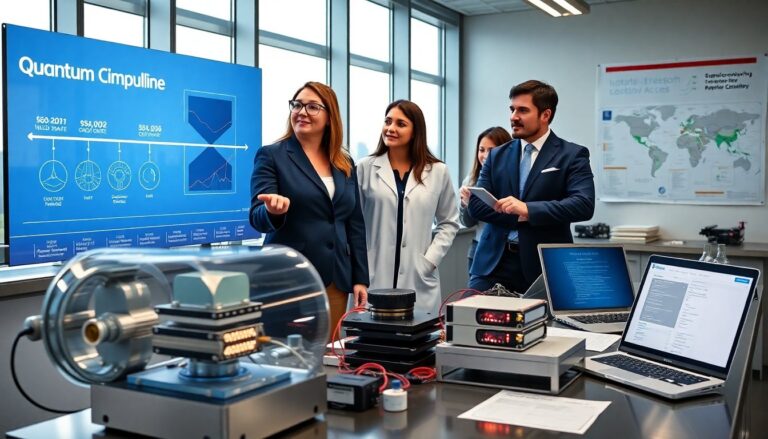
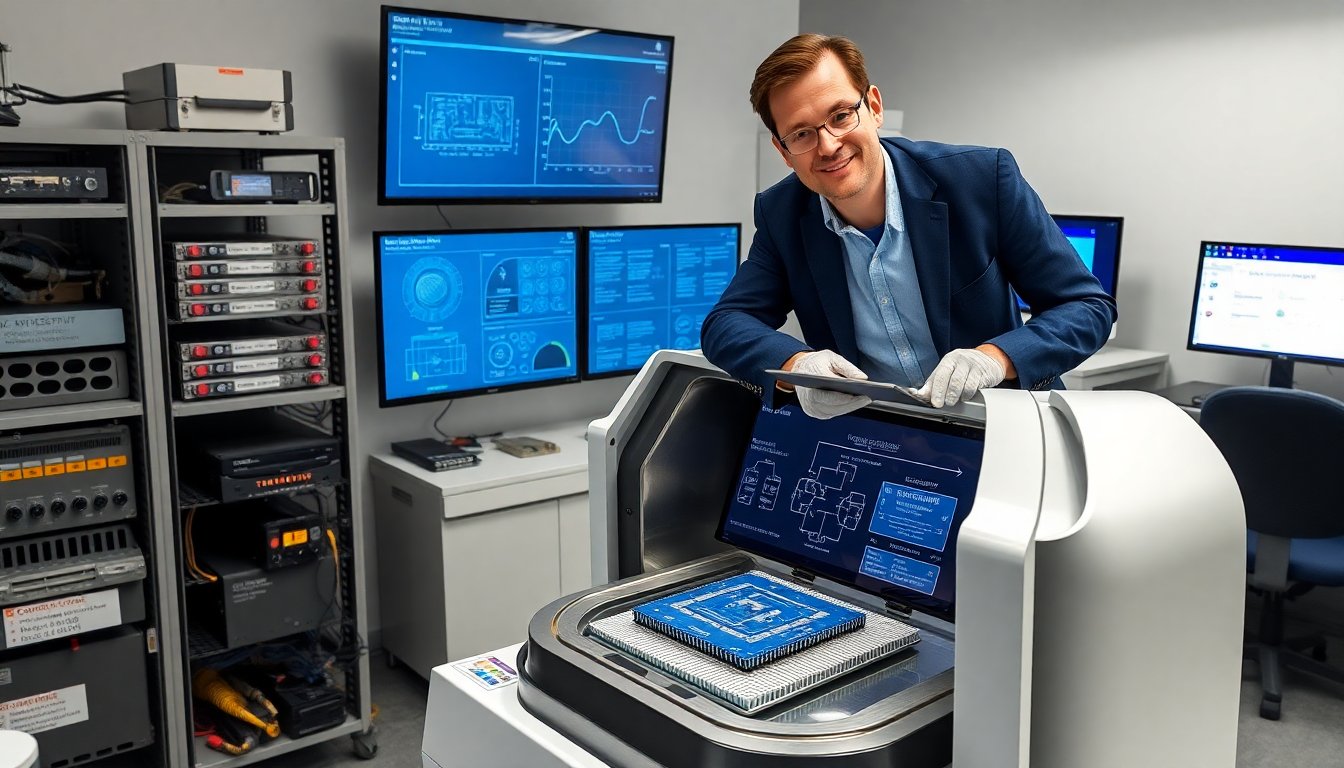

Superconducting quantum computing offers a practical path to large-scale quantum processors. It uses superconducting circuits to store and process quantum information. Researchers build qubits from Josephson junctions and resonators. Engineers cool devices to millikelvin temperatures. The field reached key benchmarks by 2026 in coherence, gate fidelity, and system size.
Key Takeaways
- Superconducting quantum computing uses circuits built with Josephson junctions to create qubits that process quantum information at millikelvin temperatures.
- Advances in coherence, gate fidelity, and system size have enabled superconducting qubits to achieve over 99.9% single-qubit fidelity by 2026, improving practical quantum computing performance.
- Error mitigation techniques like pulse shaping, dynamical decoupling, and quantum error correction codes play critical roles in reducing errors and extending qubit coherence times.
- Scaling superconducting quantum computing requires improvements in control electronics, refrigeration, and fabrication to handle thousands of qubits with higher yield and connectivity.
- Near-term applications focus on algorithms tolerant to noise, such as variational quantum eigensolvers for molecular simulations and optimization, often run on cloud-accessible superconducting processors.
- Industry collaboration and shared resources accelerate the development of scalable superconducting quantum computing toward fault-tolerant and useful early quantum applications.
How Superconducting Qubits Work: Principles, Circuit Designs, and Readout
Superconducting quantum computing uses superconducting circuits to create qubits. A circuit contains capacitors, inductors, and Josephson junctions. The Josephson junction provides a nonlinear element. The nonlinearity isolates two energy levels. Engineers label those two levels as the qubit states. Designers arrange circuits in variants such as transmons, flux qubits, and fluxonium. The transmon reduces charge noise by increasing capacitance. The flux qubit uses magnetic flux to set qubit energy. Fluxonium adds inductance to extend coherence.
A typical device sits on a chip and connects to control lines. Control lines deliver microwave pulses. Pulses carry out single-qubit rotations and two-qubit gates. The common two-qubit gate uses a tunable coupler or cross-resonance drive. The coupler lets engineers turn interactions on and off. The cross-resonance drive applies a microwave tone on one qubit that conditions the other.
Readout uses microwave resonators coupled to each qubit. A resonator shifts its frequency when the qubit state changes. A microwave probe measures that frequency shift. Amplifiers then boost the probe signal. Engineers often use quantum-limited amplifiers such as Josephson parametric amplifiers. The amplifiers improve signal-to-noise ratio. Signal processing maps the measured voltage to a qubit state. Calibration sets thresholds and corrects measurement bias.
Device packaging and wiring matter. Shielding reduces stray magnetic fields. Filtering removes high-frequency noise. Cryogenic wiring preserves signal integrity. Control electronics sit at room temperature and send shaped pulses to the cryostat. Engineers tune pulse shapes to avoid leakage and control errors.
Error Sources, Decoherence Mechanisms, and Practical Error Mitigation
Superconducting quantum computing faces errors from multiple sources. Energy relaxation (T1) causes the qubit to lose excitation. Dephasing (T2) scrambles the qubit phase. Charge noise, flux noise, and dielectric loss contribute to both. Two-level systems in materials produce loss and frequency drift. Quasiparticles that break Cooper pairs also induce errors. Control errors arise from imperfect pulse amplitude, phase, and timing.
Engineers measure error rates with randomized benchmarking and tomography. Those tests report single- and two-qubit gate fidelities. In 2026, typical single-qubit fidelities exceed 99.9% in many labs. Two-qubit fidelities approach 99.5% in optimized systems. Readout error rates vary but often sit below a few percent with good amplifiers and calibration.
Teams apply error mitigation to reduce effective error in algorithms. They use pulse shaping and DRAG corrections to lower leakage. They apply echo sequences and dynamical decoupling to extend coherence against low-frequency noise. They calibrate cross-talk and use frequency-collision avoidance when placing qubit frequencies. They also use active reset to shorten cycle time.
For logical error control, groups develop quantum error correction codes. Surface codes and repetition codes receive the most attention. Engineers carry out small logical qubits with repeated physical qubits. They perform syndrome extraction with fast, high-fidelity readout. The logical qubit still requires many physical qubits, but experiments demonstrate error detection and correction on small lattices. These experiments mark progress toward fault-tolerant superconducting quantum computing.
Scaling Roadmap, Industry Progress, and Near-Term Applications
Companies and national labs plan scaling paths for superconducting quantum computing. They increase qubit count, improve connectivity, and boost yield. They also invest in control electronics and cryogenic systems. Modular approaches link smaller processors through microwave or photonic interconnects. Monolithic chips push towards thousands of qubits on a single mount. Fabrication improvements reduce defect density and improve uniformity.
By 2026, several firms operate processors with hundreds of functional qubits. Researchers demonstrate mid-scale quantum processors that run error-mitigated algorithms. Cloud access to superconducting systems expanded. Developers run chemistry and optimization prototypes on those clouds. Industry reports show growing tool chains for pulse-level control and noise-aware compilers.
Near-term applications favor problems that tolerate noise and short-depth circuits. Variational quantum eigensolvers and quantum approximate optimization algorithms receive most attention. Teams use those algorithms for small molecular energy estimates and constrained optimization. Error mitigation and careful circuit design help extract useful results from noisy hardware. Hybrid workflows combine classical optimization with quantum subroutines.
Engineering advances target three bottlenecks. First, control electronics must scale to thousands of channels while reducing cost and power. Second, refrigeration must handle larger heat loads and denser wiring. Third, fabrication must cut frequency collisions and increase coherence yield. Progress in those areas will determine how fast systems grow.
Industry collaboration accelerates progress. Open benchmarks, shared fabrication recipes, and cross-lab validation help align goals. Investment continues in software and education to expand the user base. These efforts push superconducting quantum computing from lab demos toward useful early applications.