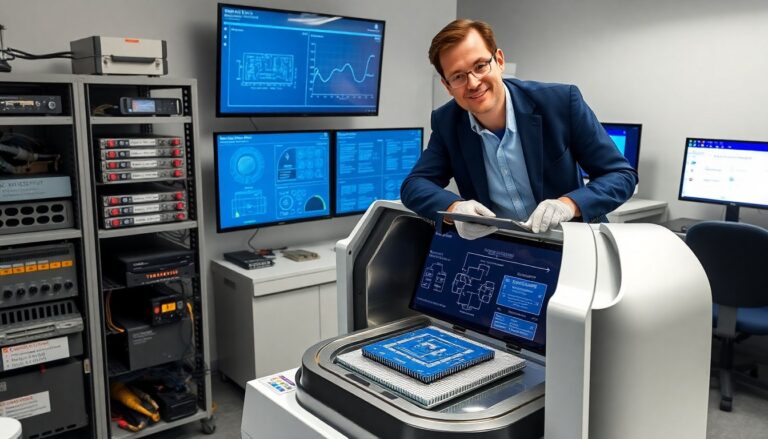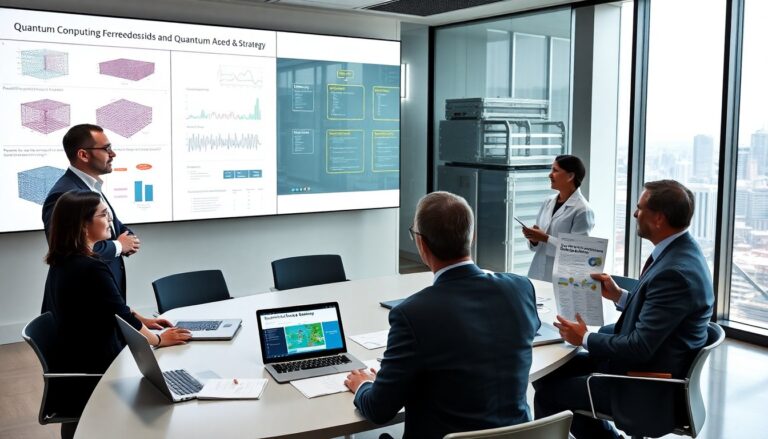
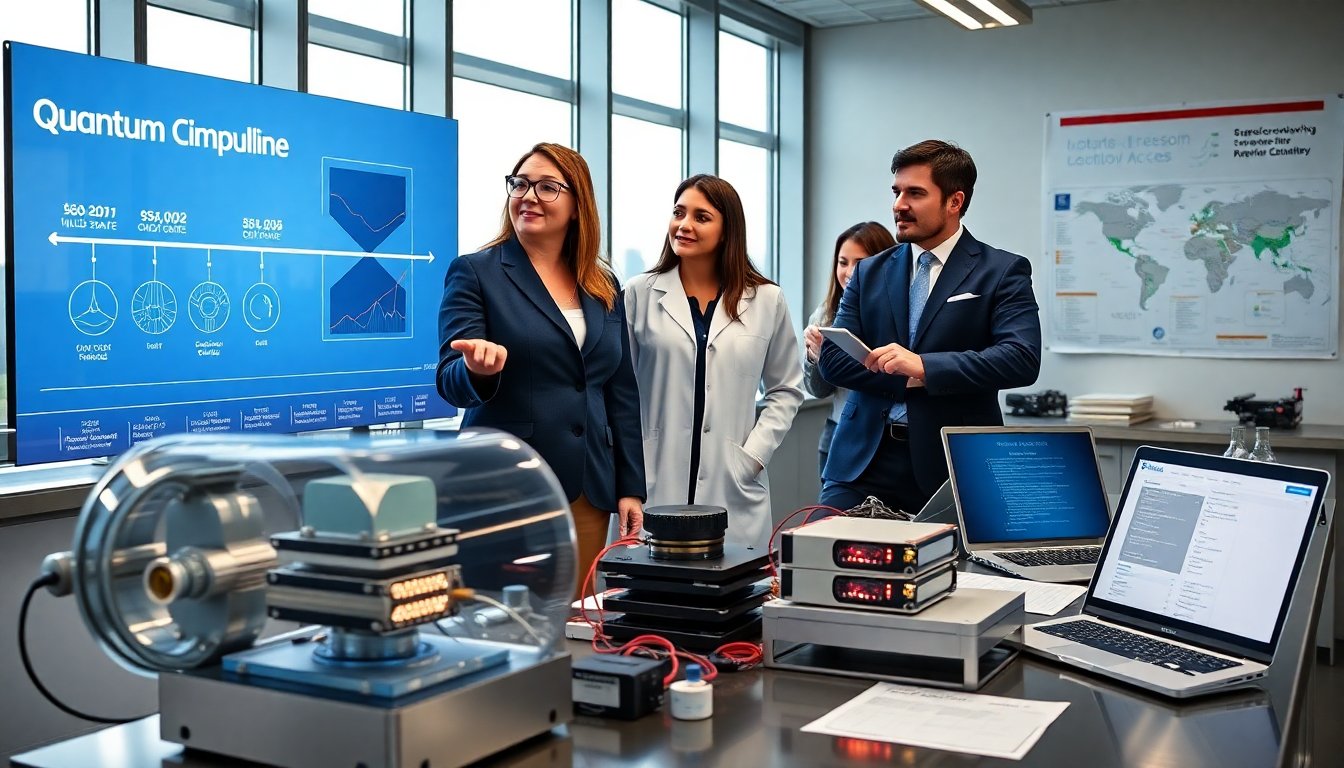

The quantum computing timeline began with theory in the 1950s and moved to practical tests by the late 1990s. This article tracks major events, key labs, and notable companies. It shows how theory turned into machines and how machines now aim for useful tasks. Readers will get a clear view of past milestones, the current state, and projected steps through 2035.
Key Takeaways
- The quantum computing timeline began with foundational theories in the 1950s and evolved to practical experiments by the 1990s.
- Significant breakthroughs between 2000 and 2024 led to multi-qubit systems and the launch of early commercial quantum computing services.
- Major advances in error correction and hardware scaling are projected between 2025 and 2035, aiming to achieve logical qubits capable of practical applications.
- Quantum computing is expected to deliver commercial value initially through specialized simulations in chemistry and materials by 2030.
- Cloud-based quantum computing services and hybrid classical-quantum workflows will facilitate broad adoption in the near term.
- Challenges like error correction complexity, supply-chain issues, and talent shortages remain but are balanced by increased funding and national roadmaps.
Foundations And Early Milestones: Theory, Algorithms, And The First Experiments (1950s–1999)
The quantum computing timeline starts with physics. Physicists in the 1950s and 1960s formulated quantum mechanics that later made quantum computing possible. In 1980, Paul Benioff proposed a quantum model of a Turing machine. In 1982, Richard Feynman argued that classical computers could not efficiently simulate quantum systems. In 1994, Peter Shor published an algorithm that factored integers exponentially faster than known classical algorithms. Shor’s work showed a clear advantage and spurred funding.
Researchers built small experiments in the 1990s. David Deutsch proposed a universal quantum computer in the 1980s. In 1995 and 1996, experimentalists demonstrated basic quantum gates with trapped ions and nuclear magnetic resonance. These demonstrations validated the core ideas of the quantum computing timeline. Universities created dedicated groups. Government agencies began funding long-term projects.
The field also produced error correction theory. In 1995 and 1996, researchers published quantum error-correcting codes. Those codes gave engineers a path to scale. The 1990s ended with working qubits in labs and a clear research agenda. The early period set timelines for later milestones and shaped expectations for commercial work.
Growth And Breakthroughs: From Prototype Devices To Early Commercial Systems (2000–2024)
The quantum computing timeline accelerated after 2000. Universities and startups moved from single-qubit tests to multi-qubit systems. In the 2000s, experimental groups increased coherence times and improved gate fidelities. In 2011 and 2012, superconducting qubits and trapped-ion systems reached tens of qubits. Companies formed to build devices and software. Major tech firms launched research programs and acquired startups.
By 2019 and 2020, providers offered cloud access to small quantum processors. That access marked the first commercial systems. In 2019, Google reported a quantum processor performing a task faster than a classical supercomputer for a narrow benchmark. That claim sparked debate and investment. Researchers in 2020 and 2021 focused on error rates and reproducibility. Academic groups and industry teams published repeated cross-checks.
Between 2021 and 2024, teams improved control electronics and cryogenics. Companies built processors with dozens to hundreds of qubits. Firms also released software stacks for noise-aware algorithms. Startups and labs tested error mitigation and primitive error correction steps. Governments published national roadmaps and increased funding. The quantum computing timeline for this era shows a mix of progress and practical limits. The field moved from prototypes to early commercial services and clearer scaling plans.
Near-Term Roadmap And Practical Timelines: Scaling, Error Correction, And Real-World Impact (2025–2035)
The quantum computing timeline for 2025–2035 focuses on scale and error control. Teams plan to increase logical qubit counts by combining physical qubits with error correction. Engineers will aim to produce logical qubits that run error-corrected algorithms for hours. Companies will invest in modular designs. They will use cryogenic control, photonic links, and improved materials.
By 2027, several groups expect to demonstrate small logical qubits that outperform equivalent noisy systems. By 2030, teams aim to run quantum algorithms for chemistry and materials simulations that give clear practical value. These simulations will target energy materials, drug leads, and catalysts. The quantum computing timeline places early commercial advantage in specialized simulation tasks rather than broad-purpose computing.
Adoption will follow provisioned cloud services. Organizations will test hybrid workflows that combine classical and quantum steps. Software teams will supply toolchains that schedule quantum runs, correct errors, and postprocess results. Standard benchmarks will emerge to compare different hardware types. The timeline assumes steady improvements in gate fidelity, coherence, and fabrication yield.
Risks remain. Error correction requires large qubit counts and engineering work. Supply-chain limits and talent gaps may slow deployment. Policymakers may update export rules and funding priorities, and those moves will affect timelines. Still, the field will likely show meaningful commercial use by the early 2030s. The quantum computing timeline through 2035 so predicts progressive scaling, targeted commercial wins, and broader ecosystem growth.