
The Razer Mamba has been a staple in the gaming peripheral world for years, and the rechargeable wireless iteration continues to prove why serious PC gamers trust it for everything from ranked competitive shooters to marathon gaming sessions. Unlike wired alternatives that anchor you to your desk or older wireless mice with disposable batteries, the Razer Mamba rechargeable wireless model delivers the responsiveness competitive players demand while eliminating cable drag and battery anxiety. Whether you’re grinding ranked matches or diving into single-player adventures, understanding what this mouse can actually do, beyond the marketing speak, matters. This guide breaks down the specs, performance, and real-world usability that makes the Razer Mamba worth considering for your setup in 2026.
Key Takeaways
- The Razer Mamba rechargeable wireless PC gaming mouse delivers sub-1ms latency and tournament-grade performance, making the wireless transition feel seamless for competitive gamers switching from wired setups.
- Its rechargeable USB-C dock eliminates battery anxiety, providing 20-24 hours of continuous play with RGB on, or 50+ hours with RGB off, requiring charging only every 2-3 days for typical 4-6 hour daily use.
- The Focus Pro 30K sensor offers consistent accuracy across 100-30,000 DPI with minimal prediction, plus a 2mm lift-off distance that prevents accidental jitter, making it trusted by professional esports players.
- At $99-129 retail (or $69-79 during sales), the Razer Mamba’s 70-million-click switches and durable build justify the mid-premium price through 4+ years of reliable performance worth roughly $2-3 monthly.
- Razer Synapse software enables cloud-synced profiles across PCs, game-specific automations, and full customization of all 9 programmable buttons, though internet is required for initial setup and cloud features.
- The 95-gram weight and palm-grip ergonomics work best for right-handed competitive players in aim-dependent games like Valorant and CS2; casual gamers or ultra-lightweight enthusiasts may find better alternatives.
What Makes The Razer Mamba Stand Out
The Razer Mamba rechargeable wireless model has maintained relevance in a crowded peripheral market because it doesn’t compromise on core requirements that competitive gamers depend on. The combination of sub-1ms wireless latency, a focus on balanced ergonomics, and consistent sensor performance gives it a solid position in the mid-to-premium gaming mouse tier.
What separates it from budget wireless mice is the engineering philosophy: Razer prioritizes responsiveness over gimmicks. The mouse delivers reliable performance without the “feel” of wireless lag that plagued older generations. Players switching from wired setups rarely report adjustment periods: the wireless transition feels seamless, which is the bar competitors like the Logitech G Pro X and SteelSeries Rival 3 aim to hit.
The rechargeable battery system is another differentiator. Rather than constantly swapping AA batteries, you get a USB-C charging dock that tops up the mouse between sessions. For gamers who put in 4-6 hours daily, this typically means charging every 2-3 days, depending on RGB usage.
Design And Build Quality
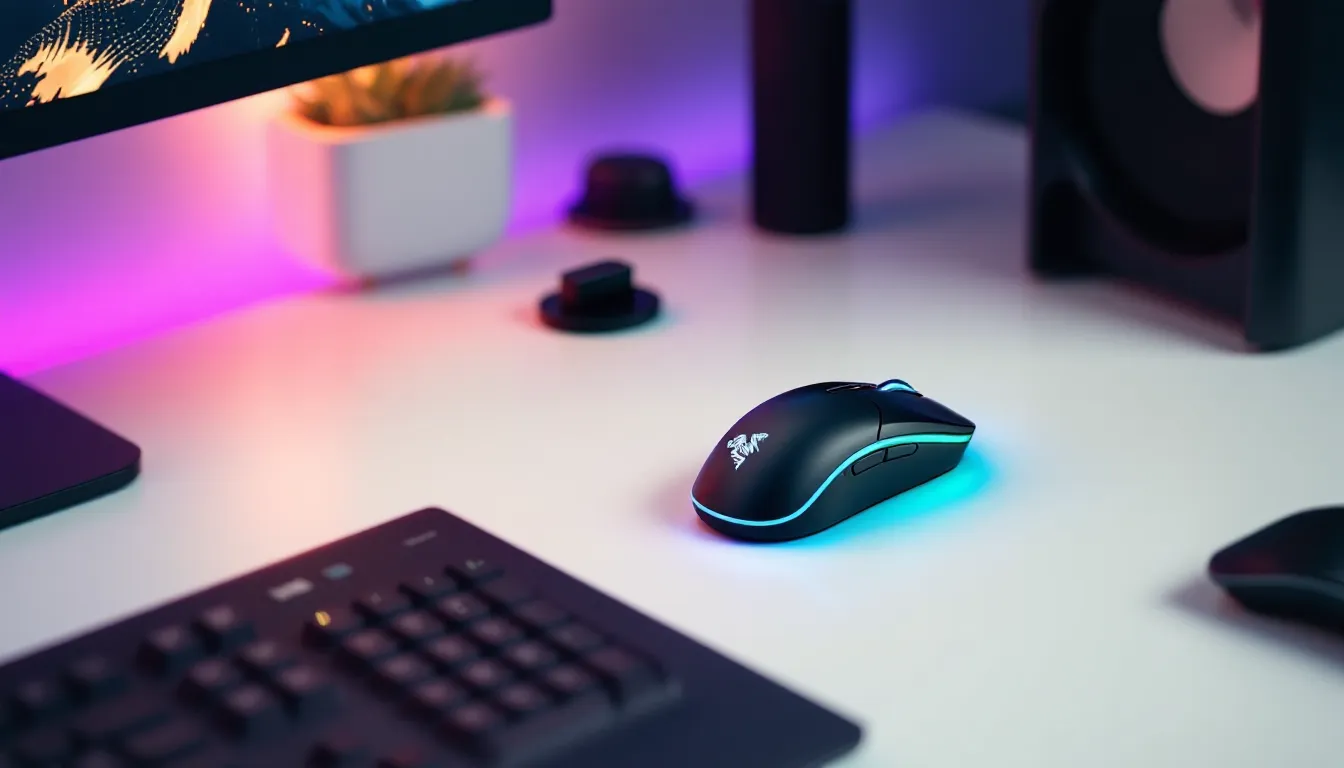
The Razer Mamba maintains a lightweight, ambi-friendly shell that works for both right-handed and left-handed players. The plastic construction is intentional, it keeps weight down while maintaining durability. At approximately 95 grams (including the internal battery), the mouse feels responsive without feeling flimsy.
The side buttons are textured and positioned for thumb access without awkward stretching. The main clicks use Razer’s mechanical switches, rated for 70 million clicks, meaning the mouse should outlast most gaming careers. Cable management isn’t an issue since this is wireless, but the dock adds a small footprint to your desk setup. Build quality feels premium for the price point: there’s no creaking, and the finish resists fingerprints reasonably well.
One practical detail: the mouse comes with grip tape pre-applied. If your hands sweat during intense matches, you’ll appreciate the extra traction out of the box. You can replace it if it wears down, and Razer sells replacements.
Ergonomics And Comfort Features
The Mamba’s ergonomics cater to right-handed players primarily, though the body shape is neutral enough that some left-handed gamers adapt to it. The contour fits a palm-grip or claw-grip playstyle better than fingertip, though that’s partially personal preference.
The mouse features a gentle arch that supports your palm without forcing an uncomfortable angle. During long play sessions, 8+ hours, the ergonomics hold up without causing hand fatigue. The weight distribution is balanced, so you’re not fighting heavy-handed moments when making micro-adjustments.
Razer includes a mousepad with some units, though quality varies. The standard cloth pad is adequate but not exceptional: gamers typically prefer their own setup, and the mouse performs equally well on most modern gaming pads. Importantly, the sensor doesn’t require a specific surface type, so you’re not locked into proprietary ecosystem gear.
Wireless Connectivity And Battery Performance
The Razer Mamba uses Razer’s proprietary wireless protocol, which operates on a 2.4GHz connection. This technology is mature at this point: Razer has refined it across multiple product generations, and latency sits well below the 1ms threshold where human perception starts to notice input lag. For context, most professional esports tournaments now accept wireless gaming mice, and the Mamba is tournament-grade in terms of connectivity reliability.
The rechargeable battery is a lithium-ion cell that charges via USB-C in approximately 2 hours from fully depleted. Real-world battery life depends on usage: with RGB lighting on full brightness, expect 20-24 hours of continuous play before needing a charge. With RGB off or dimmed, the mouse stretches to 50+ hours. This flexibility is useful: competitive players often disable RGB for marginal performance gains (reducing power draw) while streamers keep it for visibility on camera.
Range And Latency Considerations
The wireless range extends to approximately 30 feet in open space without obstacles. In a typical gaming setup, mouse on desk, receiver a few inches away, you’ll never hit range limitations. If you’re using a large multi-monitor setup with the receiver positioned behind a monitor or tucked in a cable hub, the range still covers you.
Latency is the critical metric. The Mamba maintains a 1ms wireless polling rate at 1000Hz, matching the responsiveness of wired mice. In shooters like Valorant or Counter-Strike 2, where millisecond-level precision matters, the wireless performance is indistinguishable from wired. This is where the mouse justifies its price premium over budget wireless alternatives that skimp on polling rate.
Charging Speed And Battery Life
The 2-hour full charge time is respectable but not industry-leading. Some competitors hit full charge in 90 minutes, but the difference rarely impacts real-world usage unless you’re a streamer who relies on the mouse constantly throughout the day.
Battery degradation over time is another consideration. Lithium-ion cells gradually lose capacity, typically retaining 80% of original capacity after 2-3 years of daily use. Razer doesn’t publish official replacement timelines, but the battery should remain functional for 3+ years before noticeable drops occur. If you’re planning to keep the mouse for 4-5 years, eventual battery replacement might become necessary, but Razer support can advise on whether that’s cost-effective at that point.
Performance Specifications For Competitive Gaming
The Razer Mamba’s sensor is the Razer Focus Pro 30K, a proprietary optical sensor capable of tracking up to 30,000 DPI. For competitive gaming, DPI is just one variable, consistency and accuracy matter more than raw numbers. The Focus Pro 30K delivers both through a 650-inch-per-second tracking speed and minimal prediction (spinning up movements and predicting trajectory), which is critical for flick-based shooters.
The mouse supports on-the-fly DPI adjustment via dedicated buttons, allowing you to toggle between sensitivity presets without pausing or entering menus. Competitive players often keep multiple profiles, a lower sensitivity for long-range engagements and a higher sensitivity for close quarters, and the Mamba’s hardware buttons let you switch instantly.
Accuracy is tested via lift-off distance, which measures how far the mouse can rise above the surface before losing sensor tracking. The Mamba achieves approximately 2mm lift-off, which is excellent. This prevents accidental double-clicks or jitter from picking the mouse up between flicks, a common frustration with cheaper sensors.
DPI Settings And Accuracy
The DPI range spans from 100 to 30,000, but practical competitive settings cluster between 400-3,200. Professional esports players across Valorant, CS2, and Overwatch 2 typically use DPI settings in the 400-800 range paired with in-game sensitivity adjustments, allowing them to maintain muscle memory across different titles.
The sensor’s accuracy is consistent across the entire DPI range. Unlike some mice where low DPI becomes “jittery” or high DPI feels “floaty,” the Mamba maintains linearity. This consistency is why it’s used by professional players: when your gear is reliable, you can focus on improving your actual aim instead of fighting the equipment.
Razer’s software allows you to program DPI “steps,” so you’re not jumping from 800 to 3,200. You can set incremental increases (e.g., 800, 1,200, 1,600, 2,000) and cycle through them mid-game, though most players settle on 2-3 preset sensitivities for different game modes.
Sensor Technology And Response Time
The Focus Pro 30K uses Razer’s proprietary sensor technology, which relies on a 5G chip for processing. The 5G designation refers to internal processing speed, not network connectivity. This allows the sensor to make tracking decisions 5 times per millisecond, which is faster than competing sensors in its price range.
Response time, the interval between you moving the mouse and the cursor updating on screen, sits at approximately 0.2ms, which is imperceptible. To put this in perspective, human reaction time averages 150-300ms, so a 0.2ms response time is effectively invisible. The bottleneck in competitive gaming isn’t the mouse’s response: it’s your monitor refresh rate (60Hz = 16.7ms per frame, 240Hz = 4.2ms per frame, 360Hz = 2.8ms per frame) and your own reflexes.
One technical note: some competitors publish response time claims that include network latency or include processing time from the game engine itself. Razer’s 0.2ms figure isolates the mouse’s contribution, which is the fair metric. Professional gaming setup guides emphasize that the mouse is one component in a chain that includes your monitor, keyboard, PC hardware, and game engine: all must be optimized for truly competitive performance.
Software And Customization Options
The Razer Mamba integrates with Razer Synapse, Razer’s unified software platform for configuring peripherals. Synapse is cloud-based, meaning your profiles sync across multiple PCs if you use the same Razer account. This is convenient if you have a gaming PC at home and a laptop for travel: your sensitivity, button mapping, and lighting preferences follow you.
The software is required for full customization, though the mouse functions at a basic level without it. If you don’t install Synapse, the Mamba works as a standard wireless mouse with fixed DPI and lighting. Competitive gamers typically install Synapse immediately to unlock button mapping and sensitivity profiles.
System requirements are modest: Windows 10 or later, or macOS 10.15 or later. No special hardware is needed beyond the receiver dongle, which connects via USB-A or USB-C (adapter included). Linux support is limited: Synapse is Windows/macOS only, though the mouse functions as a generic HID device on Linux with basic controls.
Button Mapping And Macro Programming
The Mamba has 9 programmable buttons: left/right click, scroll up/down, scroll-click, forward/back side buttons, and a dedicated DPI cycling button. Each button can be remapped to a different action or programmed with macros.
Macro programming is straightforward in Synapse: you record a sequence of actions (e.g., “press ability key, wait 0.5 seconds, press attack”) and assign it to a button. For competitive games, macros are typically disabled to ensure fair play, esports rulesets prohibit automated input sequences. But, for single-player games or MMOs, macros are useful for ability rotations or resource gathering.
Key remapping is more practical for competitive use. Players often rebind the forward/back side buttons to abilities or utilities relevant to their game. In Valorant, a common setup is mapping one side button to an ability and the other to the spike: in CS2, side buttons might control buy menu or grenades. The flexibility allows you to optimize for your muscle memory.
RGB Lighting And Profile Management
The Mamba features RGB lighting along the scroll wheel and a side accent strip. Lighting is purely cosmetic but customizable through Synapse. You can set static colors, breathing effects, spectrum cycling, or reactive modes (lighting responds to mouse movement).
Profile management is where Synapse shines. You can create game-specific profiles that automatically activate when you launch a particular game. For example, your Valorant profile loads with specific DPI, button mapping, and RGB setting: switching to Elden Ring automatically loads a different profile optimized for that game. This automation eliminates manual switching and reduces error.
Synapse stores up to 5 onboard profiles in the mouse’s memory, so settings persist even if you swap PCs or uninstall the software. The cloud backup means your configurations are recoverable if you need to reset the mouse or troubleshoot connectivity issues.
One consideration: Synapse requires an internet connection for initial setup and cloud sync, though the mouse functions offline once configured. If you’re on a LAN or isolated network, you can use Synapse in offline mode with limitations.
Comparing The Razer Mamba To Competitors
In the wireless gaming mouse market, the Razer Mamba competes directly with the Logitech G Pro X (approximately $139), SteelSeries Rival 3 (approximately $79), and the Corsair M75 Wireless (approximately $99). Each has different strengths.
The Logitech G Pro X matches the Mamba in wireless latency and adds a slightly lighter weight (63 grams vs. 95 grams). But, the G Pro X uses standard AA batteries, requiring periodic replacement. The Mamba’s rechargeable system eliminates that friction. Logitech’s software (G Hub) is considered more intuitive by some users, though both Synapse and G Hub are cloud-dependent.
The SteelSeries Rival 3 is the budget alternative at half the Mamba’s price. It delivers acceptable wireless performance and a 18,000 DPI sensor, sufficient for casual and mid-tier competitive play. But, it lacks on-the-fly DPI adjustment buttons and uses AA batteries. If your budget is strict, the Rival 3 is a reasonable entry point: if you’re already invested in Razer peripherals, the Mamba integrates better with your ecosystem.
The Corsair M75 Wireless sits between the Mamba and Rival 3 in price. It’s lighter (75 grams) and offers similar latency performance. Corsair’s software (iCUE) is also cloud-based but operates as a unified platform across their entire peripheral lineup. The decision between Corsair and Razer often comes down to existing peripheral ecosystem, what keyboard, headset, or mousepad you already own.
According to professional gaming configurations, the Mamba remains popular in esports organizations, particularly for players transitioning from wired mice. The familiarity with Razer’s ecosystem and the prevalence of Razer gear in tournament setups mean players can borrow backup equipment if needed without adjusting to unfamiliar gear.
For value-to-performance ratio, the Mamba sits in the “premium mid-tier” category. It’s not the cheapest wireless option, nor is it a high-end luxury mouse like the Finalmouse UltralightX (exclusive, $99, very limited). Instead, it targets gamers who want reliable, proven performance without paying for exotic materials or extreme lightweighting that may sacrifice durability.
Price Point And Value Proposition
The Razer Mamba rechargeable wireless typically retails between $99 and $129, depending on sales and region. This positions it in the accessible premium tier, not budget, not luxury, but solidly mid-range for quality gaming peripherals.
For this price, you’re paying for proven wireless technology, a solid sensor, customizable software, and rechargeable convenience. The real value proposition lies in durability: Razer’s 70-million-click switches and the overall build quality mean the mouse typically outlasts cheaper alternatives by 2-3 years. If you spread the cost over 4 years of daily use, the per-month expense is roughly $2-3, which is economical for a device you touch 8+ hours daily.
Sales and discounts occur frequently, Black Friday sales drop prices to $69-79, and seasonal promotions offer 20-30% off. If you can wait for seasonal sales, the effective value improves significantly. Checking PC gaming peripheral reviews during sale seasons often reveals timing windows where premium mice hit budget pricing.
Alternatively, if you’re a hobbyist or casual player, a $79 wireless mouse may be sufficient. The Mamba is an optimization for players who’ve determined that peripheral quality impacts their gameplay and want to eliminate variables. For professional esports players, the cost is a business expense: the mouse pays for itself through performance improvements and consistent reliability.
Warranty coverage is typically 2 years in the US, with Razer’s support generally responsive to defects. Out-of-warranty repairs or replacements aren’t offered at discount, but the warranty period is reasonable for a consumer electronics device.
Who Should Buy The Razer Mamba
The Razer Mamba is ideal for competitive gamers who spend significant time in fast-paced, aim-dependent games like Valorant, CS2, Apex Legends, or Overwatch 2. If your gameplay depends on consistent, reliable tracking and low-latency input, the Mamba delivers.
It’s also a strong choice for players transitioning from wired to wireless peripherals. The minimal latency makes the switch feel transparent, eliminating the concern that wireless is sacrificing responsiveness. If you’ve been hesitant about wireless due to past experiences with laggy mice, the Mamba’s sub-1ms latency proves that modern wireless technology is ready for competitive play.
Players already invested in the Razer ecosystem benefit from integrated software and profile management. If your keyboard, headset, or mousepad are Razer peripherals, adding the Mamba creates a cohesive setup where all devices sync settings and RGB lighting from a single control hub.
Casual and single-player gamers don’t require the Mamba’s performance overhead. A budget wireless mouse handles Stardew Valley, Baldur’s Gate 3, or The Sims 4 equally well. The premium is justified only if you’re targeting competitive performance or have strong preferences for specific features like on-the-fly DPI buttons and rechargeable batteries.
Streamers and content creators should consider the Mamba if aesthetics and RGB synchronization matter. The mouse’s visible RGB and software integration allow for customized lighting that matches stream overlays or setup theming. For production purposes, the cable-free design also simplifies cable management in tight desk setups.
One final consideration: if you prefer ultra-lightweight mice (under 60 grams), the Mamba’s 95-gram weight may feel heavy after extended use with lighter alternatives. Weight preference is deeply personal: test both if possible before committing. Some players thrive with the Mamba’s weight for stability: others prefer the minimalist feel of lighter mice. Your play style and preference matter more than absolute specifications.
Conclusion
The Razer Mamba rechargeable wireless gaming mouse delivers on the core promise: reliable, responsive wireless performance without the friction of disposable batteries or cable drag. Its Focus Pro 30K sensor, programmable buttons, and Synapse integration make it a capable tool for competitive gaming, while the build quality suggests it’ll outlast trend cycles.
It’s not the lightest mouse, the cheapest option, or the most exotic, it’s the pragmatic choice for gamers who want proven performance without gambling on emerging brands or technology. The recharging system is genuinely convenient, the wireless latency is tournament-grade, and the customization depth supports both casual and competitive play.
If you’ve been contemplating a upgrade from a wired mouse or looking for a reliable wireless replacement for an aging peripheral, the Razer Mamba justifies its position in the mid-premium tier. The price is fair for the feature set, and the long-term reliability means you’re unlikely to regret the investment. Test one if possible, weight and shape preferences vary, but odds are, you’ll find it a solid addition to your gaming setup.