
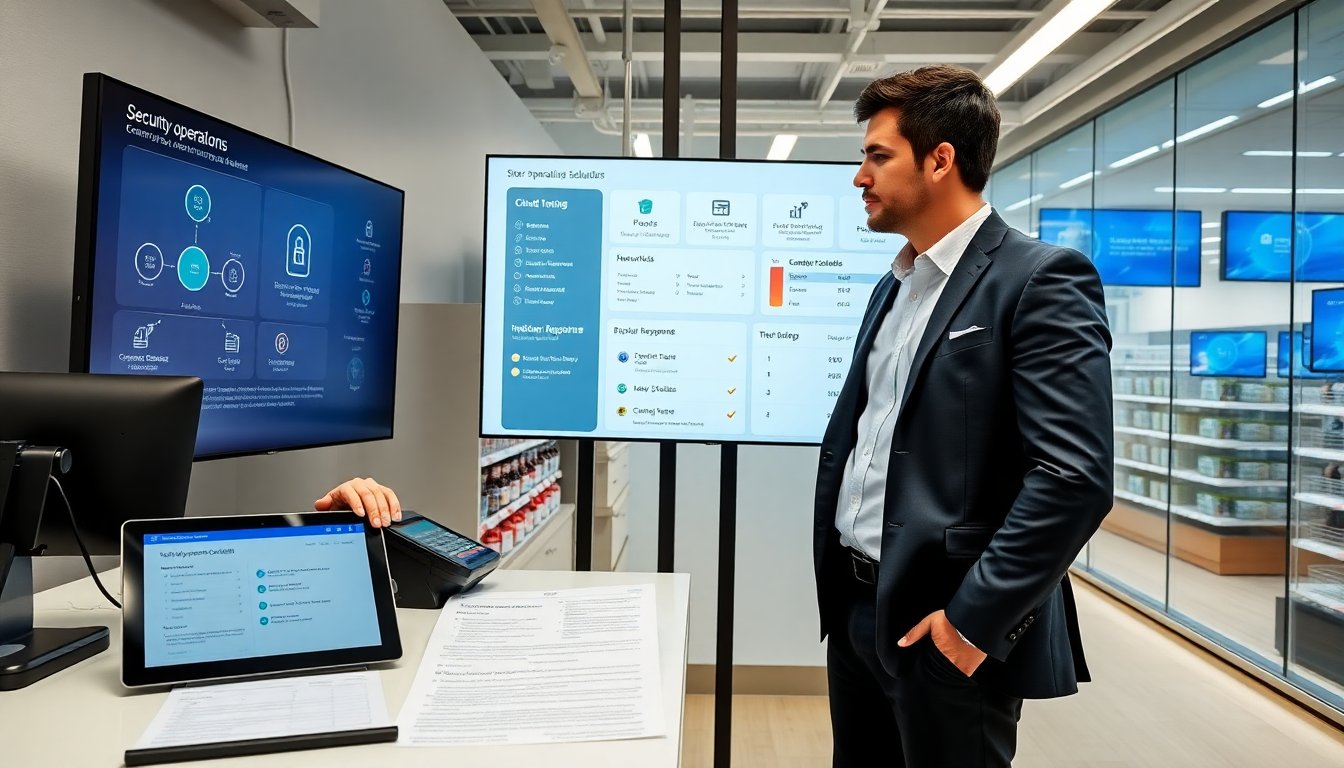

Retail cybersecurity must start with clear risk lists and simple actions. Retailers must assess where they take payments, store customer data, and run networks. The team must list devices, vendors, and access points. They must set priorities by impact to customers and to revenue. This plan helps leaders reduce breaches, protect payments, and keep stores open.
Key Takeaways
- Retail cybersecurity starts with identifying risks in payment systems, customer data storage, and network access to prioritize protection efforts.
- Retailers face threats like POS malware, phishing, ransomware, supply-chain attacks, and insider risks that can disrupt operations and harm revenue.
- Effective retail cybersecurity includes strong access controls, network segmentation, patched endpoints, encrypted transactions, and fraud detection measures for both physical and online stores.
- Vetting and monitoring third-party vendors, encrypting data, and running regular backups with tested recovery plans are crucial to preventing data breaches and minimizing downtime.
- Incident response planning, compliance with PCI DSS, staff training on security awareness, and continuous monitoring with clear metrics enhance retail cybersecurity readiness and resilience.
Top Cyber Threats Facing Retailers Today
Retail cybersecurity faces several clear threats that target customers, payments, and operations. Attackers exploit weak point-of-sale systems. They steal card data and sell it on underground markets. Attackers also target online checkout pages. They inject skimming scripts to capture card details as customers type. Phishing attacks remain common. Employees click malicious links and give away credentials. Attackers then access back-office systems and customer databases.
Ransomware hits retail operations and logistics. Attackers encrypt inventory and payroll files. Stores may close until teams pay or recover data. Supply-chain attacks also pose risks. Attackers infect software updates or vendor tools. Retailers then receive compromised code that spreads across stores and warehouses. Insider risk adds another layer. Disgruntled or careless staff copy data or disable security tools.
Retail cybersecurity must also address cloud misconfigurations. Retail teams often move apps to cloud services and leave storage buckets open. Attackers find those gaps and extract customer lists and transaction logs. Fraudsters use card-not-present fraud to drain cards and test stolen data. They target rewards accounts and gift cards. Retailers must treat these threats as business risks and measure potential losses in dollars, brand trust, and operational downtime.
Practical Security Measures For Brick‑And‑Mortar And Online Retail
Retail cybersecurity improves when teams adopt layered controls that fit both stores and web shops. They should start with strong access control. Staff must use unique accounts and multifactor authentication for point-of-sale terminals, admin consoles, and cloud portals. Teams should revoke access when employees leave.
Retailers should segment networks. They must separate payment systems from guest Wi-Fi and from corporate systems. Segmentation reduces the blast radius when a device is compromised. Retailers should also harden endpoints. They must keep POS terminals, tablets, and store laptops patched. They must run anti-malware and limit which apps can install.
For online stores, retailers must protect checkout flows. They should use Content Security Policy and Subresource Integrity to block skimming scripts. They must tokenize card data and use a payment gateway that supports strong encryption. Retail cybersecurity improves when companies use fraud detection that flags anomalies in payment patterns and account behavior.
Retailers should secure third parties. They must vet vendors, require security attestations, and limit vendor access to only needed systems. They should monitor vendor activity and log all remote sessions. Data encryption at rest and in transit must be standard. Retailers should also adopt endpoint detection and response on servers that host customer data.
Finally, retailers must run regular backups and test recovery. They should store backups offline and verify that recovery works. This step reduces the risk of lasting shutdown after ransomware or data loss.
Incident Response, Compliance, And Staff Training Essentials
Retail cybersecurity succeeds when teams prepare to respond and comply. They must write a short incident response plan that names roles and steps. The plan must include who isolates systems, who talks to vendors, and who notifies customers. Retailers should run tabletop drills twice a year. Drills reveal gaps and speed decision making.
Retailers must track legal and card network rules. They should follow PCI DSS requirements for payment data. They must keep evidence of scans, patch records, and employee training. Regulators may require breach notification. Retailers should prepare templates for customer notices and regulator reports.
Staff training reduces errors. Employees should learn how to spot phishing, secure terminals, and report incidents. Training should include quick checklists for store managers and IT staff. Retail cybersecurity improves when staff test simulated phishing campaigns and receive immediate, simple feedback.
Retailers should also set up clear monitoring and logging. They must collect logs from POS, web servers, firewalls, and vendor connections. They should use automated alerts for unusual logins, large data exports, or failed backups. Retail teams can use cloud services or managed providers to scale monitoring without large internal teams.
Finally, retail leaders must measure security with a few clear metrics. They should track time to detect, time to contain, the number of failed patches, and the percentage of systems with multifactor authentication. These metrics help leaders decide where to invest and show progress to auditors and boards.